Head Shape & Positioning · August 26, 2026 · 5 min read
Baby Flat Head Helmet: A Guide to the First 4 Months
Written by Kristi Brelsford, DPT, PCS

By Dr. Kristi Brelsford, pediatric physical therapist and founder of The Village SLC
If you’ve noticed signs of a baby flat head and are wondering whether a helmet might help, you’ve come to the right place!
Recommendation for a helmet or a ‘cranial remolding orthosis’ or not will depend on several factors, including your child’s age and the severity of the head flattening, in addition to a full-body evaluation.

When does a baby flat head helmet actually help?
A baby helmet ‘cranial remolding orthosis’ is used for head shaping. See my other blog post, “Baby Flat Head (Plagiocephaly): Causes, Severity, and Treatment”, for more background information on head flattening, especially the most common type, called plagiocephaly and why we care about head flattening. Plagiocephaly is when the baby’s head is flat on one side.
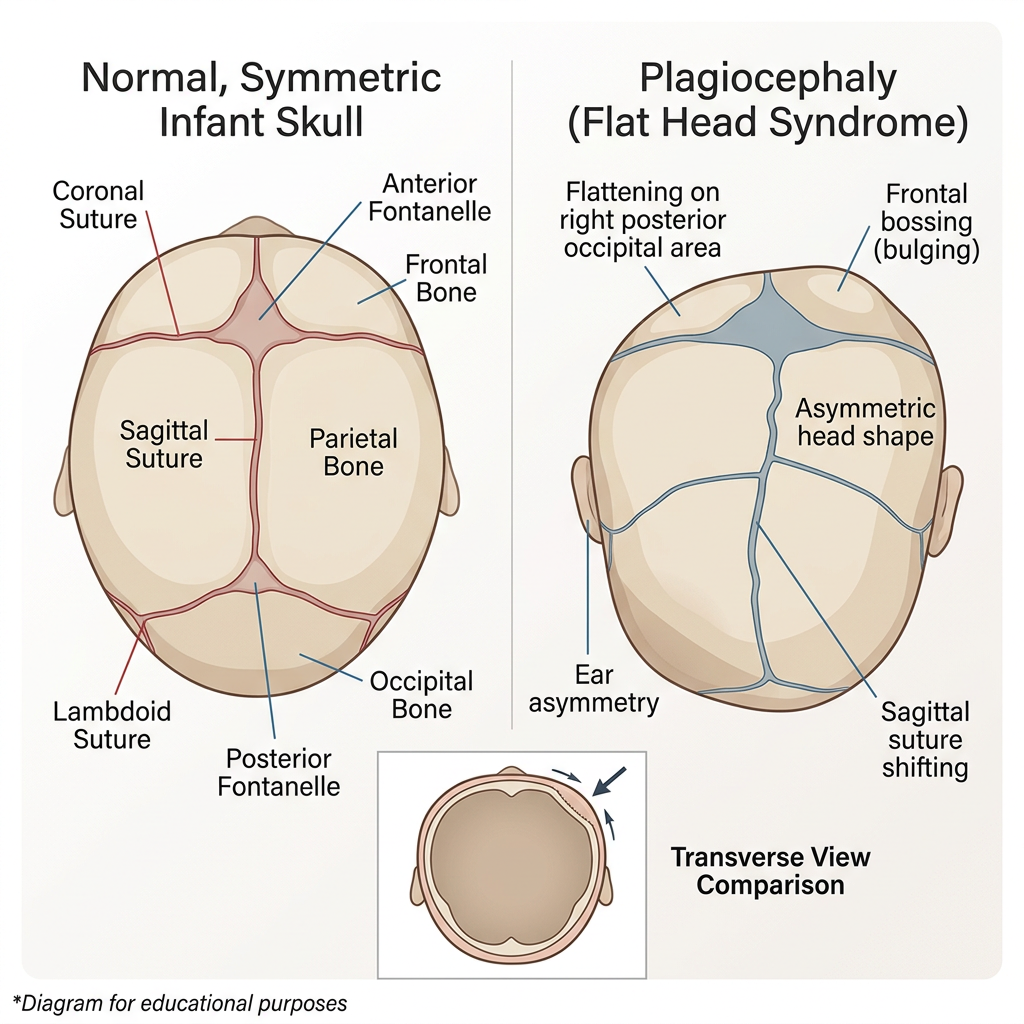
Will plagiocephaly go away on its own?
Mild plagiocephaly may resolve on its own, but moderate to severe plagiocephaly is unlikely to resolve on its own and will likely impact your child’s motor development.
What to know about plagiocephaly treatment?
Plagiocephaly can be improved, and in some cases even reversed with physical therapy! Depending on the severity of the plagiocephaly and the age of the child, the plan of care will look different, so reach out to a provider for an evaluation.
If you are in the Salt Lake Valley, I offer in-home visits and would love to work with you — reach out to get started!
Does it matter when my child starts physical therapy?
Yes it does! An infant’s skull is very malleable when they are born in order to allow for their head to pass through the birth canal. The skull has ‘soft spots’ called fontanelles when a baby is born. As the child grows and ages, these spaces become smaller and the skull hardens.
The skull is very moldable with repositioning until around 4 months, but as the child ages, the skull hardens more and it becomes more difficult to change the shape of the skull. If the infant is younger, repositioning and physical therapy may be the first course of action, but an 8-month-old infant with severe plagiocephaly is more likely to need a baby flat head helmet (also called a ‘cranial remolding orthosis’) right away, alongside physical therapy.
Why does PT look different for each child?
Every child is unique and can have different factors affecting their head and body, which is why a full evaluation is important to make sure everything is addressed for your child.
What does physical therapy look like for plagiocephaly?
Physical therapy will encompass looking at the whole child because often if the head is flat, the neck will be asymmetrical which can affect the whole body down the chain including the child’s arms, trunk and legs. Physical therapy would start with an evaluation to determine what all is going on with your specific child. Likely some pieces of treatment will be repositioning, stretches, active movement, gross motor play, environmental adaptations, parent/caregiver education and parent training.
What does a baby helmet cost?
In the United States, a cranial remolding helmet typically runs in the low thousands of dollars — commonly cited ranges are roughly $1,500–$3,000, varying by provider, region, and how many adjustment visits are included. The helmet is fitted and managed by an orthotist, and the price usually covers the scan, fabrication, and follow-up adjustments.
Insurance coverage varies a lot. Some plans cover helmets when documented as medically necessary — typically requiring a prescription and measurements showing moderate-to-severe flattening — while others classify them as cosmetic and decline. Before committing, ask your insurer specifically about “cranial remolding orthosis” coverage, and ask the orthotist’s office what documentation they submit. And one more reason early physical therapy matters: when repositioning and PT start young, many babies improve enough to skip the helmet conversation entirely.
Why are helmets so common now?
Babies spend a lot of time on their backs! ‘Safe sleep’ practices recommended by the American Academy of Pediatrics changed in 1994 in the USA, recommending ‘Back to Sleep’ to try to reduce Sudden Infant Death Syndrome (SIDS). Before 1992, 70% of infants slept on their tummy and plagiocephaly was fairly rare (1/300). By 1997, plagiocephaly had increased five times and has continued to increase, today up to 46%. By the late 1990s, SIDS rates were cut in half, so the recommendation by the American Academy of Pediatrics for infants to sleep on their back is here to stay.
Quick answers for parents
Does my baby need a helmet for a flat head?
It depends on your child’s age and the severity of the flattening. A full-body evaluation determines whether repositioning, physical therapy, a helmet, or a combination is right for your baby.
Will plagiocephaly go away on its own?
Mild plagiocephaly may resolve on its own. Moderate to severe plagiocephaly is unlikely to resolve without treatment and can affect motor development.
When is a helmet recommended instead of repositioning?
A baby’s skull is most moldable before about 4 months. Older infants with severe flattening, for example an 8-month-old, are more likely to need a helmet along with physical therapy.
Can physical therapy fix a flat head without a helmet?
In many cases, yes. Plagiocephaly can be improved, and sometimes reversed, with physical therapy, especially when treatment starts young.
How much does a baby flat head helmet cost?
Commonly cited US ranges are roughly $1,500–$3,000 depending on provider and region. Insurance sometimes covers it when documented as medically necessary — ask your insurer about “cranial remolding orthosis” coverage.
References:
Castaño-Bustos D, Agudelo-Arrieta M, Ocampo-Navia MI, Chacón-Valencia SE, Pérez-Méndez W, Vergara-Lago M. Is helmet therapy effective in positional plagiocephaly? A systematic review and proposal for an updated management algorithm. Childs Nerv Syst. 2026;42(1):236. Published 2026 Jun 1. doi:10.1007/s00381-026-07306-9
Corte AD, Rohde MA. Use of orthotic helmets in children with positional plagiocephaly and brachycephaly: a systematic review. Childs Nerv Syst. 2025;41(1):163. Published 2025 Apr 22. doi:10.1007/s00381-025-06826-0
Farzan J, Nguyen L, Bogursky A, et al. Advancing Preliminary Findings: A Follow-up Study on Parental Education to Prevent Plagiocephaly. Ann Plast Surg. 2026;96(Suppl 5):S260-S264. doi:10.1097/SAP.0000000000004615
Branch LG, Kesty K, Krebs E, Wright L, Leger S, David LR. Deformational plagiocephaly and craniosynostosis: trends in diagnosis and treatment after the “back to sleep” campaign. J Craniofac Surg. 2015;26(1):147-150. doi:10.1097/SCS.0000000000001401
Disclaimer: The information on this account is for educational purposes only and is not medical advice. Viewing or interacting with this content does not create a therapist-patient relationship. Every child is unique, and individualized recommendations require an appropriate evaluation. Always consult your own healthcare provider for concerns about your child and seek immediate medical care for emergencies.